WHAT ARE WORKING DOG OPERATIONS?
Working dog operations encompass the training, handling, and deployment of dogs used for clearly defined official, security, law enforcement, or military tasks. Depending on their role, working dogs may perform a wide range of duties, including protection work, apprehension, human scent detection, tracking, article searches, and specialized detection work.
This versatility is often underestimated. Working dog operations involve far more than protection work or apprehension scenarios. A significant portion of modern working dog work is based on the dog's nose. Dogs search for people, track human scent, locate objects, and identify specific target odors. Detection dogs may be trained to locate narcotics, explosives, currency, electronic storage devices, accelerants, or other operationally relevant scent pictures.
What matters is not appearance but reliable performance in a clearly defined task. A working dog must be motivated, resilient, controllable, and capable of working appropriately in demanding situations. The dog must be independent enough to solve problems while remaining responsive to the handler and integrated into the overall mission.
WHAT MAKES A GOOD WORKING DOG?
A suitable working dog requires far more than drive. Motivation is important, but it must be channeled correctly. A working dog should work actively without becoming uncontrollable. The dog must be resilient under pressure while remaining responsive to the handler. It should be capable of searching, tracking, or securing independently without operating outside the handler's control.
Environmental stability is equally important. Depending on the assignment, working dogs may encounter buildings, vehicles, slippery floors, darkness, loud noises, crowds, confined spaces, and constantly changing terrain. A dog that only performs reliably in familiar training environments is only partially prepared for real-world deployments.
Key characteristics include:
- Strong nerves and confidence
- Environmental stability
- Trainability and handler focus
- Physical endurance
- Reliable indication and working behavior
- Clear communication with the handler
- The ability to switch between high drive and control
Successful working dog performance is never accidental. It results from suitable genetics, systematic training, experience, and skilled handling.
WHY WORKING DOG OPERATIONS ARE ALWAYS A TEAM EFFORT
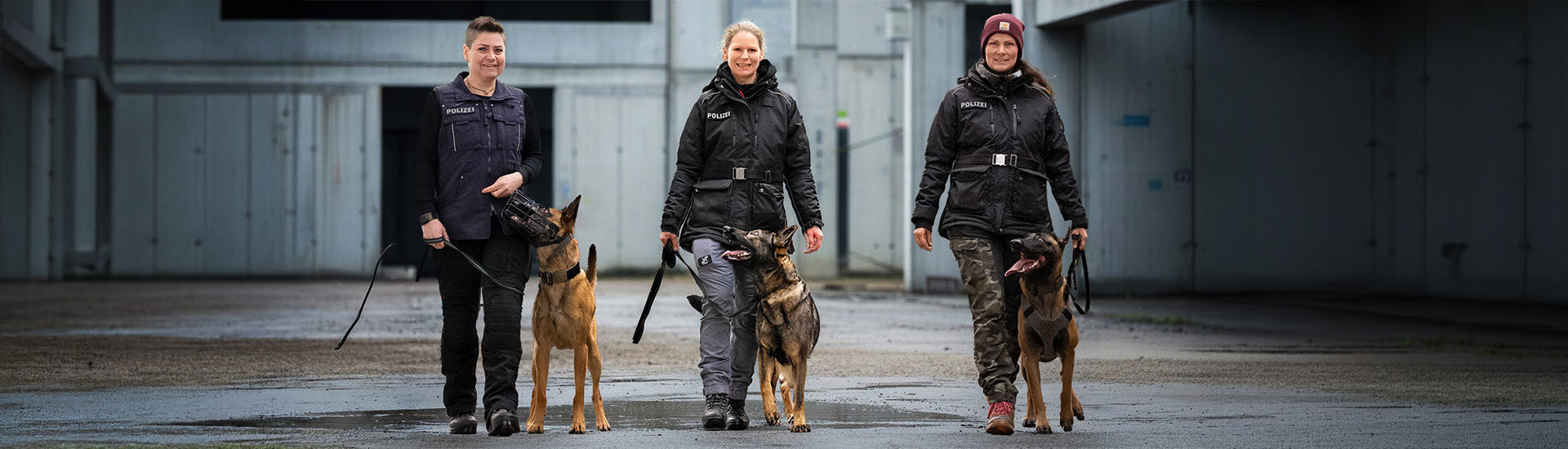
In working dog operations, it is never just the dog that works. It is always a team: handler and dog.
The dog contributes its abilities—its nose, attention, search behavior, speed, endurance, and reliability under pressure. The handler must direct those abilities. The handler reads the dog, evaluates situations, delivers rewards correctly, provides clear communication, and knows when to intervene or allow the dog to work independently.
In practice, a working dog handler is responsible for much more than handling the dog. Equipment, radios, identification panels, leashes, rewards, paperwork, and operational gear must all remain accessible without restricting movement.
That is why functional clothing is more than a comfort feature in working dog operations. Equipment such as the IQ K9 Working Dog Handler Vest Pro Black is designed specifically for this environment. It provides storage capacity, identification panels, body camera attachment points, radio loops, and quick access to mission-critical equipment. In dynamic situations, equipment must be immediately available rather than buried inside a bag.
WHY WORKING DOG EQUIPMENT REQUIRES A DIFFERENT APPROACH
Traditional dog sport clothing is primarily designed for training. Working dog equipment often needs to do much more. It must be durable, allow unrestricted movement, carry essential gear, and remain organized at all times. Depending on the operational environment, identification, color requirements, and rapid access to equipment can also be critical.
A good example is the IQ Police Dog Handler Vest Blue. It is designed for environments where a professional appearance, identification options, and practical handler functionality are required. Its value comes not simply from additional pockets but from combining operational functionality, identification capabilities, and fast access to equipment.
Working dog operations also take place in all weather conditions. Training, searches, and deployments may involve rain, wind, cold temperatures, darkness, or long waiting periods. If the handler becomes cold, soaked, or unable to organize equipment effectively, performance suffers.
Products such as the MFJ K9 Pro Black Tactical Dog Handler Jacket were developed specifically for these demands. Designed for professional K9 handlers, the jacket offers weather protection, insulation, body camera loops, holster access, rear storage pockets, and removable treat pouches, helping handlers remain organized and effective even under difficult conditions.
WORKING DOG OPERATIONS ARE NOT JUST PROTECTION WORK
One of the most common misconceptions is that working dog operations consist primarily of protection work. Protection and apprehension tasks can be important components, but they represent only part of the field.
A major area is scent work. Search work serves as the umbrella term and may include human scent detection, tracking, article searches, and detection work. Detection work generally refers to locating specific target odors that have been conditioned through training, such as substances, objects, or human scent signatures.
In practical applications, the dog must do far more than simply "search." The dog must work systematically, persistently, and reliably. It must recognize a target odor, distinguish it from competing environmental stimuli, and communicate the find clearly to the handler.
For this reason, training development in scent work is highly demanding. Repetition is important, but training must not become predictable. If search locations, hiding spots, surfaces, and reward placements remain unchanged, dogs may learn patterns rather than true scent discrimination.
Tools such as the IQ Magnetizer can help create more varied and realistic training scenarios. By allowing toys, bite tugs, bite pillows, or scent containers to be positioned magnetically, trainers can create more diverse reward placements and less predictable search environments. This can be particularly useful in scent work, detection training, and professional K9 applications.
Training aids do not replace proper training systems, but they can help make training more versatile, practical, and realistic.
WHY CONTROL MATTERS MORE THAN TOUGHNESS
Working dog operations are sometimes associated with toughness. In reality, control is far more important.
A working dog must be capable of operating with intensity while remaining fully manageable. Depending on the task, the dog may search, indicate, apprehend, or secure. At the same time, the dog must also stop, wait, redirect, and respond immediately to the handler.
This applies equally to detection work and protection work. A dog with unlimited energy but limited control quickly becomes a liability. A dog that lacks initiative and confidence will also struggle to perform reliably.
Successful working dog performance depends on balance: clear drive within clear rules. The dog should want to work while remaining controllable. It should solve problems independently without becoming disconnected from the handler.
The ability to switch between activation, control, and renewed engagement is one of the defining characteristics of a well-trained working dog.
WHAT SPORT DOG HANDLERS CAN LEARN FROM WORKING DOG OPERATIONS
Dog sport and working dog operations are not the same. Sport follows fixed rules and exercises. Working dog operations focus on practical objectives and constantly changing situations. Nevertheless, there are valuable lessons that sport handlers can learn from professional working dog programs.
One important lesson is environmental stability. A dog should not perform only on a familiar training field. Exposure to different environments, surfaces, sounds, and distractions helps build more reliable performance.
Equipment management is another transferable skill. Handlers who constantly search for leashes, rewards, toys, or training aids lose timing and clarity. Well-organized equipment does not automatically improve training, but it helps handlers work more efficiently and consistently.
Perhaps the most important lesson is mindset. It is not enough for a dog to perform under ideal conditions. The real question is whether the dog can perform reliably under distraction, pressure, and changing circumstances.
5 COMMON MISCONCEPTIONS ABOUT WORKING DOGS
1. Working dog operations are only about protection work
Protection and apprehension tasks represent only one part of the field. Many working dogs primarily perform search, detection, or other specialized tasks.
2. A working dog simply needs to be tough
Resilience, control, and proper training are far more important than toughness alone.
3. Motivation replaces training
Drive is important, but without structure, indication behavior, obedience, and clear communication, it remains unreliable.
4. A successful sport dog automatically makes a good working dog
Dog sport and operational work require different skill sets. A dog can excel in sport while being unsuitable for certain working roles.
5. Equipment is unimportant
In working dog operations, equipment must function reliably. Storage, accessibility, weather protection, identification, and freedom of movement can directly affect performance.
CONCLUSION: WORKING DOG OPERATIONS ARE TASK-ORIENTED WORK
Working dog operations are far more diverse than many people realize. They include protection and apprehension tasks, human scent detection, tracking, article searches, and specialized detection work. At the center of all these disciplines is reliable performance in a clearly defined task.
A good working dog requires suitable genetics, training, resilience, and skilled handling. The dog must be independent enough to solve problems while remaining controllable enough to work safely as part of a team.
Likewise, handlers need structure, experience, and functional equipment. Effective working dog performance is not built on toughness or luck. It is built on training, teamwork, communication, and the ability to perform reliably under challenging conditions.
Related: Complete K9 Handler Equipment Collection · Dog Sport Training Equipment