What Is IGP? Tracking, Obedience and Protection Explained
The three disciplines of working dog sport, explained simply.
IGP is the world’s leading working dog sport – a demanding test of tracking, obedience and protection that showcases the partnership between dog and handler at the highest level.
Originally developed to evaluate working dogs for police and military service, IGP has evolved into an internationally recognised sport governed by the FCI and practised by competitors across Europe, North America and beyond.
Whether you’ve heard the terms IGP, IPO or Schutzhund, this guide explains how the sport works, what the three disciplines involve, how the IGP 1–3 levels are structured and how to get started in working dog training.
Backed by the expertise of Dr. Florian Knabl (multiple IGP World Champion) and Patricia Knabl (lawyer and IGP competitor), co-founders of the K9andSports initiative. At IQ Dogsport we develop our equipment together with top-level competitors – what matters in training flows straight into this guide.
What does IGP mean?
IGP stands for Internationale Gebrauchshundeprüfung, the international working dog sport governed by the Fédération Cynologique Internationale (FCI). Competitors around the world are judged according to the official FCI IGP Trial Regulations and compete under a common international rulebook.
The goal of the sport is versatility: a healthy, fit, obedient dog that works closely with its handler. That is exactly why the IGP path doesn’t begin with IGP itself, but with the BH Companion Dog Test (BH/VT). It includes a temperament and traffic section, in which the dog must prove that it moves safely in everyday situations and shows no aggression toward people or other dogs. The dog must already demonstrate solid basic obedience and confidence in its environment – only then can it enter IGP trials.
Schutzhund, IPO or IGP – What’s the Difference?
They all refer to essentially the same sport. Historically, the sport was known as Schutzhund, later VPG and then IPO. Since 2019, the official international designation has been IGP. The term Schutzhund remains widely used in North America and other English-speaking countries, while IGP is now the official FCI title. If you see references to Schutzhund training, IPO dog sport or IGP training, they generally describe the same working dog sport.
The three disciplines of IGP
An IGP trial consists of three phases completed on the same day. Each is scored out of a maximum of 100 points – so 300 points are possible in total, and each phase must be passed with at least 70 points.
Phase A – Tracking
The dog follows a previously laid track with a deep nose across varied terrain (e.g. meadow or field) and precisely indicates dropped articles. IGP tracking calls for concentration, stamina and clean indication – the dog works calmly and independently, the handler only accompanies. Tracking is the quietest but technically most underrated discipline: systematic build-up is what counts, especially article indication and a clear start of the track. For building a separate, repeatable indication behaviour, the IQ Article Trainer 2.0 is ideal.
→ More in our guide: Building IGP Tracking: Calm Work, Article Indication and Clear Routines
Phase B – Obedience
Here the team shows the precise execution of exercises: heelwork, sit, down and stand from motion, retrieving over the hurdle and the A-frame, plus the down under distraction while another dog works on the field. In IGP obedience, precision and motivation matter equally. Judges evaluate technical accuracy, teamwork and the dog’s willingness to work with enthusiasm, confidence and focus. Important to understand about the sport: lack of motivation, missing joyful expression or visible negative stress lead to heavy point deductions. A dog that merely “functions” but shows no joy wins nothing in IGP.
→ More in our guide: Building IGP Obedience: Why Precision Saves Time Later · Book Gemeinsam erfolgreich zur meisterhaften Unterordnung
Phase C – Protection
The protection phase tests obedience and nerve strength under controlled conditions. The dog searches for a helper in the blinds, performs a bark-and-hold, prevents escape attempts and immediately releases on the out command. The focus is not aggression, but controlled prey motivation, arousal, obedience and lightning-fast impulse control.
→ More in our guide: IGP Protection: Why Great Protection Training Doesn’t Start with the Bite · Book Gemeinsam erfolgreich zum meisterhaften Schutzdienst
IGP levels: IGP 1, IGP 2 and IGP 3
The three IGP levels build on one another:
- IGP 1 – the entry level after passing the BH Companion Dog Test. All three phases, but with lower requirements.
- IGP 2 – increased difficulty in distance, duration and complexity.
- IGP 3 – the highest level with the most demanding exercises; the basis for regional, national and international championships.
A performance judge scores each phase separately. Only the combination of nose work, obedience and protection creates the picture of a versatile, well-trained dog.
What really counts at championship level
At regional events, national championships and world championships, it is no longer enough for a dog to simply perform the exercises in the rulebook.
Judges look for dogs that work with confidence, focus and expression. They should be motivated, attentive and resilient without appearing nervous or hectic. The highest scores go to teams whose performance clearly shows that dog and handler work as one.
Performances like these are not achieved through pressure or short-term training. They are the result of a structured progression, clear communication and training that gives the dog confidence and security.
The best IGP dogs in the world don't just work precisely. They work with conviction.
Does IGP make dogs aggressive? Does it increase the risk of bite incidents?
This is the most common concern about the sport – and it usually rests on a misunderstanding that starts with equating IGP with “biting”. In reality IGP consists of three equally weighted disciplines, and two of them involve no helper at all:
- In IGP tracking the dog works calmly, with concentration, alone on the track.
- In IGP obedience it’s about precision, cooperation and joy in working with the handler.
Both require the very opposite of aggression: self-control, concentration and teamwork.
What really happens in the protection phase
From the outside you see speed, barking, a helper and the bite – which is exactly why protection training is so often misunderstood. But good protection work doesn’t start with the bite; it starts with structure, control and clean training. The dog works throughout on command and as a team with its handler, and its arousal is clearly directed at a single object: the sleeve. The bite is only one building block among many:
- Searching the blinds – actively searching, the dog detaches from the handler,
- Bark-and-hold – clearly indicating the helper through a bark-and-hold, without touching him,
- Preventing escape and defending against attacks – controlled, on command,
- The out – releasing immediately on the out command,
- Guarding and handler control – staying calm and remaining controllable between the exercise parts.
The demanding part is switching between these phases: the dog should work intensely and powerfully and still remain responsive at all times. Control and energy are not opposites – a good protection dog shows both. What is tested above all is impulse control and obedience under high arousal – the opposite of uncontrolled aggression.
→ In depth on our blog: IGP Protection: Why Great Protection Training Doesn’t Start with the Bite
Aggressiveness is not aggression
A key misunderstanding lies in the terms themselves. Aggressiveness is the readiness present in every animal – it usually shows up as communication: growling, wrinkling the nose, a cut-off signal (“this far and no further”). Aggression is the escalation that occurs when these signals are missed or ignored – that’s when a bite incident happens. This is precisely where almost all bite incidents originate: in misread signals and mistakes in upbringing and handling, not in the sport.
And the bite statistics? The facts
1. Prey motivation is not aggression. Behaviourally, work on the sleeve corresponds to natural prey and play behaviour (arousal directed at an object) – not social aggression (threatening or harming a living being). The veterinary behaviour specialist Dr. Esther Schalke puts it in a nutshell: for the dog, the sleeve is nothing more than a prey reward – like a ball, only of higher value.
“Who walks down the street with a bite sleeve, after all?” — Dr. Esther Schalke
2. Why it doesn’t carry over into everyday life (signal control). Trained cleanly, the protection phase is tied to clear key stimuli: helper with sleeve in the blind = signal for the bark-and-hold; person without sleeve = no signal at all. A dog trained this way therefore does not transfer its behaviour to people in daily life. Dogs learn in a highly place- and situation-specific way – the sport stays on the training field, with protective suit, rituals and commands.
3. Sport dogs barely appear in bite statistics. An analysis of expert reports on bite incidents in Bavaria (Mikus dissertation, 2006) found that 87.6% of the dogs that became conspicuous were family dogs, whereas dogs trained as protection dogs accounted for only 2.2% (males) and 0% (females) – the study concluded that “well-trained sport and protection dogs pose no danger potential.” A Swiss annual statistic (mandatory reporting) likewise contained, among around 270 bite incidents, only a single sport dog – and that one did not come from protection sport.
4. Training is what matters, not the sport. It only becomes dangerous when a dog is pushed into defensive aggression through pressure and learns that aggression against people “works” – which is a no-go in the sport. Built on prey motivation, this conflict does not arise in the first place. Important to know: training a deployable service dog is fundamentally different from the sport – the two cannot be equated. Studies confirm it: stress and problem behaviour come from aversive training methods, not from the discipline (Vieira de Castro et al., 2020). Prong collars and electronic stimulation devices have been banned in Germany since 2022 (§ 2 (5) TierSchHuV).
5. Aggression is penalised in the sport, not rewarded. If a dog shows uncontrolled aggression in a trial, it is disqualified and must repeat the BH Companion Dog Test including the temperament/traffic section. The sport therefore actively selects against insecure, aggressive behaviour.
6. Stress is not the same as suffering. The positive tension in the sport (eustress) must be distinguished from harmful chronic stress (distress) and is essential for learning. Well-conditioned dogs quickly return to calm after work (Accorsi et al., 2018; Cocco et al., 2025).
Strong dogs don’t bite
Paradoxical but true: protection training doesn’t make dogs more dangerous, but calmer. The sport gives the dog an outlet to channel its energy in a regulated way – a self-assured, fulfilled dog doesn’t need to prove its strength in everyday life. Through the constant switches between high arousal and absolute control (comparable to a biathlete who must shoot calmly right after the sprint), the dog learns to respond to commands in any state of arousal – making it more controllable in an emergency, not less.
From practice – Team Heuwinkl: For over 35 years we have trained protection dogs at the highest international level – and never has a dog from our circle been involved in a bite incident. That is no coincidence, but the result of clean training in motivation and control. The book Gemeinsam erfolgreich zum meisterhaften Schutzdienst describes the full training logic behind it.
More than that: the sport is a service to society
Where do police, customs and border control get their dogs? From working-dog breeding lines whose dogs are run in the protection sport. Service and sport draw on the same resource – and the majority of dogs go to private owners and into the sport. It is precisely this sport that selects the traits service dogs need: drive to work, handler control, resilience, stress resistance and noise insensitivity / gun steadiness. While noise sensitivity is increasing among purely family dogs (and is often treated with medication), it remains low in working dogs – because it is deliberately selected for.
From practice – Dr. Florian Knabl (IQ Dogsport founder, multiple IGP World Champion, co-founder of K9andSports): “If owners no longer ran their working dogs in the sport, the selection relevant to service would disappear – and very soon there would no longer be enough deployable service dogs.”
So without the organised sport, this foundation for public safety would collapse.
Is IGP healthy for the dog? What research shows
Done properly and reward-based, working dog sport has demonstrably positive effects – for the dog and for the team:
- Stronger bond: working together on demanding tasks deepens the relationship. In sportingly active teams, dog and owner synchronise hormonally far more strongly than in purely family dogs (Sundman et al., 2019).
- Species-appropriate enrichment: the dog uses its natural abilities – nose, movement, brain work. This prevents under-stimulation and the problem behaviour that arises from it.
- Fulfilment and confidence: mastering tasks makes dogs more content and resilient; in cognitive tests, positively trained dogs show an “optimistic bias” – a core indicator of high quality of life.
- Responsibility and structure: the sport fosters a conscious, responsible way of working with the dog – fixed routines, clear communication and attention to its needs.
- Physical outlet: training acts as a valve for tension; cortisol levels often drop right after the session.
- Composure in everyday life: a survey by veterinarian Dr. Simon Bach suggests that IGP-trained dogs even behave more calmly at the vet – a sign of good socialisation and controllability.
Health first: modern training means more than the three disciplines
Responsible working dog training puts the dog’s health first. Today that naturally includes complementary conditioning: targeted strength and mobility work that prepares muscles and joints for the load, plus a warm-up before and cool-down after every session. This keeps the dog fit and supple in the long term – just like any human athlete. Equally decisive are reward-based training and sufficient recovery.
Interesting: the specific discipline – tracking, obedience or protection – had no differing effect on stress hormones in research. What matters is not what, but how you train.
Is IGP permitted and recognised?
Yes. IGP is an established, regulated sport practised under the FCI rulebook, and it is designed to be animal-welfare-compliant. Individual misconduct, as exists in any sport, can be addressed with existing rules and laws; a blanket ban would be unnecessary and disproportionate. (As our co-founder and lawyer Patricia Knabl puts it: in boxing, too, you’re not allowed to deliberately break someone’s nose – and yet the sport as such is not called into question.)
In a notable sign of its cultural standing, Germany’s UNESCO Commission recognised working-dog activity as intangible cultural heritage in March 2025 – the purposeful training of dogs to support people, valued as a cultural practice.
How do I get started in IGP dog sport?
- Find a club near you. IGP is organised through clubs affiliated with national kennel clubs and FCI member organisations – above all the breed clubs (for German Shepherds, Belgian Malinois, Rottweilers, Boxers and others). A good club with experienced trainers is the most important first step.
- Pass the BH Companion Dog Test (BH/VT). It is the entry ticket to all further trials.
- Get to know the disciplines. Many start with tracking and obedience before protection is added. Especially in tracking and obedience, much can also be worked on outside the club.
- Equip yourself properly. From the dumbbell to the multifunctional belt to a well-fitting harness – the right equipment makes building up training cleaner.
→ Equipment for getting started with IGP: discover training accessories
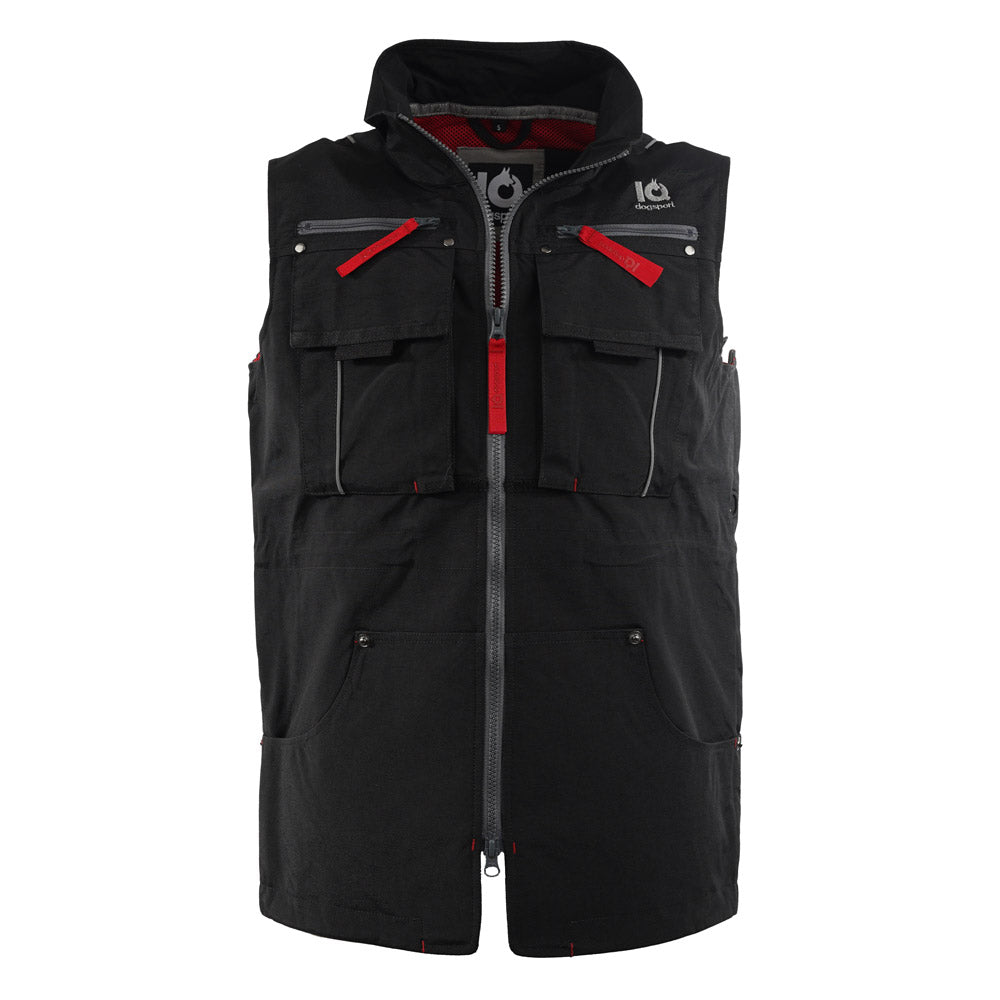
For precise and consistent training routines, IGP training vests with a back pocket, chest pockets and modular treat pouches are especially useful.
Point of contact: K9andSports e.V.
A great point of contact is the non-profit association K9andSports e.V., co-founded by IQ Dogsport founder Dr. Florian Knabl together with Patricia Knabl, Connie and Peter Scherk. It lists numerous ambassadors – experienced competitors, trainers, service-dog handlers and scientists from many countries who are happy to help with advice and support. K9andSports works to preserve healthy, capable working dogs and offers, among other things:
- Help and networking: an international ambassador network as contacts for sport, training and breeding,
- Youth development: free training and helper camps as well as seminar places for under-25s (over 600 places awarded), plus a mentoring network,
- A bridge between sport and service: exchange between competitors, service-dog handlers, breeders and breed clubs,
- Animal welfare & science, plus public-relations and outreach work at national and international level.
Go deeper: our IGP guides, equipment and books
Our discipline guides (blog):
- Building IGP Tracking: Calm Work, Article Indication and Clear Routines – incl. IQ Article Trainer 2.0 & IQ Tracking Flag
- Building IGP Obedience: Why Precision Saves Time Later
- IGP Protection: Why Great Protection Training Doesn’t Start with the Bite – incl. IQ Pop-Up Blind & IQ Performance Pro Cobra & Blind Search Pole Set
Our equipment comparisons:
- Dog training vests compared
- K9 handler vests compared
- IGP protection blinds compared
- Dog training belts compared
Reference books by Dr. Florian Knabl and Peter Scherk (both multiple IGP World Champions): Gemeinsam erfolgreich zur meisterhaften Unterordnung, …zum meisterhaften Schutzdienst and …zur Begleithundprüfung → to the books
FAQ
What does IGP mean in dog sport?
IGP stands for Internationale Gebrauchshundeprüfung – the international working dog sport governed by the FCI. It has three disciplines: tracking, obedience and protection, judged according to the official FCI IGP Trial Regulations.
What is the difference between IPO and IGP?
It’s the same sport. It was previously called Schutzhund or VPG, then IPO; since 2019 the official FCI name is IGP.
What is the difference between Schutzhund and IGP?
Schutzhund is the historical name of the sport. Today, the official FCI designation is IGP, although many handlers still use the term Schutzhund.
What do IGP 1, 2 and 3 mean?
Three levels building on one another. IGP 1 is the entry level (after passing the BH Companion Dog Test), IGP 3 the highest level and the basis for championships.
What breeds compete in IGP?
German Shepherds, Belgian Malinois, Rottweilers, Dobermans, Boxers and many other working breeds successfully compete in IGP around the world.
Can any dog do IGP?
While IGP was originally developed for working breeds, many dogs can participate in aspects of the sport if they are healthy, motivated and trained appropriately.
Does IGP make dogs aggressive or increase the risk of bite incidents?
No. IGP consists of three disciplines – tracking and obedience require concentration and cooperation, with no helper at all. In the protection phase the dog works on command as a team with its handler; the bite is only one part – searching the blinds, the bark-and-hold without contact and the immediate out test impulse control above all. Bite statistics attribute incidents to upbringing and handling errors and name no dogs run in the protection sport. The sport tends to make dogs calmer: it teaches them to respond to commands in any state of arousal.
Are dogs trained in protection dangerous in everyday life?
No. Dogs learn in a highly place- and situation-specific way. The protection phase is tied to the training field, fixed rituals and commands; a sport dog does not transfer this to everyday situations. On the contrary – thanks to the trained control, a well-handled protection dog is more controllable in an emergency.
Is a working dog sport like IGP healthy for the dog?
Done properly and with positive reinforcement, yes. Research shows positive effects on the human–dog bond, confidence and mental health. The prerequisites are reward-based training, sufficient recovery and complementary conditioning (strength and mobility work, warm-up and cool-down).
What are the benefits of IGP dog sport?
IGP strengthens the bond between dog and handler, gives the dog species-appropriate enrichment (nose, movement, brain work), provides fulfilment and confidence and prevents under-stimulation. For the handler it means a conscious, responsible partnership and a shared goal.
How do I start with IGP?
Through a club affiliated with your national kennel club or an FCI member organisation – breed clubs are a great entry point. First the BH Companion Dog Test (BH/VT) is taken, after which entry into IGP 1 is possible. The association K9andSports e.V. also supports beginners.
What equipment do I need for IGP dog sport?
Depending on the discipline: dumbbells, tracking accessories, a multifunctional belt and a well-fitting harness, among others. You’ll find equipment recommendations in our training accessories.
About the manufacturer
IQ Dogsport is a German manufacturer of dog sport equipment, based in Pfaffenhofen, Germany. The range covers dog sport vests, multi-function and training jackets, reward systems and IGP training equipment – in service with K9 handlers in the police, customs service, prison service and armed forces. More about IQ Dogsport
IQ INSIDER
More knowledge. One step ahead.
Training insights, an early look at new drops and benefits reserved for IQ Insiders.
- Training knowledge from real-world experience
- New drops — be among the first to hear
- Exclusive discounts for IQ Insiders
Your welcome benefit